
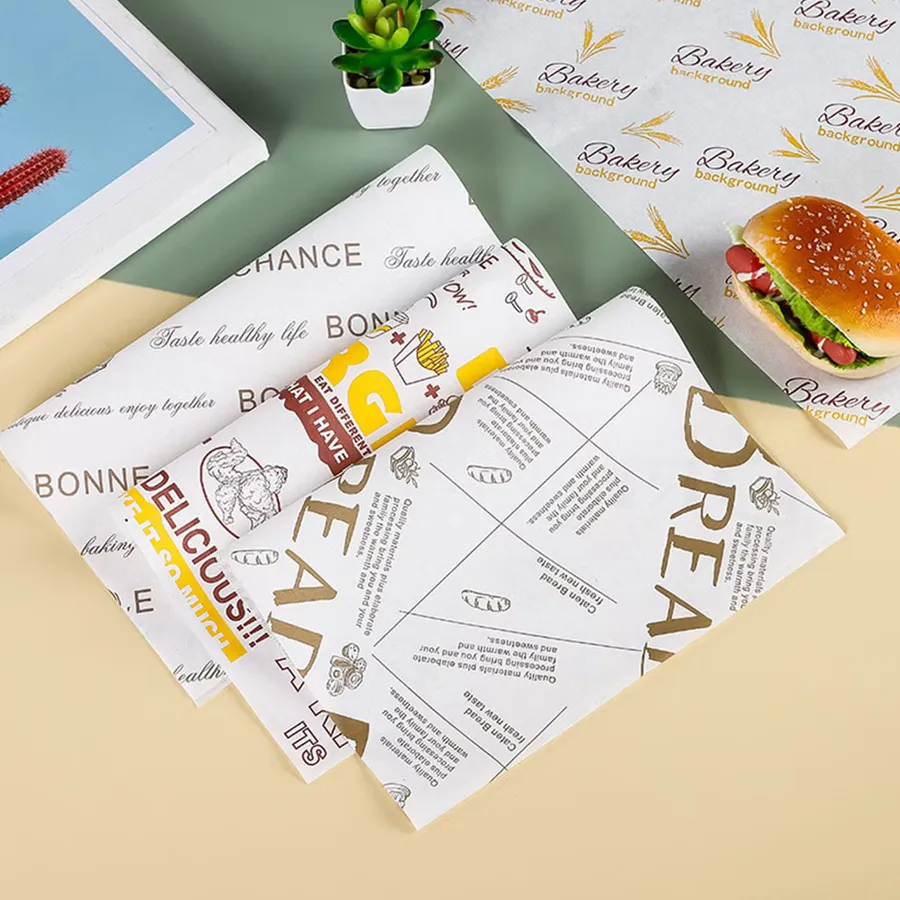
Wrap, line, and present burgers, sandwiches, pastries, pizza slices, and other takeaway foods with custom printed papers. Choose food-safe materials, grease-resistant coatings, tailored sheet sizes, branded patterns, and vibrant printing for restaurants, bakeries, cafés, food trucks, and events.
Description
Food printed papers provide a practical way to wrap, line, separate, and present different food products while keeping business branding visible. They can be used for burgers, sandwiches, wraps, pastries, cookies, pizza slices, fries, fried foods, deli products, and takeaway meals.
The paper can feature a repeating logo, brand pattern, product message, color scheme, or complete custom design. This turns a simple food-contact sheet into part of the customer experience. It can be placed inside boxes, baskets, trays, and serving containers or wrapped directly around suitable products.
Businesses that need coordinated packaging for papers, boxes, cups, sleeves, and takeaway containers can explore additional solutions through The Food Boxes.
The selected paper should suit the food’s grease, moisture, heat, weight, and intended contact period. Lightweight paper may work well for dry bakery products, while burgers, fried foods, and heavily sauced meals require a more grease-resistant structure.
Common options include grease-resistant paper, kraft paper, coated sheets, wax-treated papers, and other suitable food wrapping materials. White paper creates a clean base for bright colors and detailed logos. Natural kraft paper provides a simple brown surface for rustic and artisan branding.
Businesses requiring sheets tailored to specific products can use custom food paper in selected dimensions, materials, and printed styles.
Burgers, fries, fried chicken, cheese, pastries, and other foods can release grease that passes through ordinary paper. This may stain trays, boxes, tables, clothing, and customers’ hands. Grease-resistant paper helps manage oils and keeps the exterior presentation cleaner.
The required resistance depends on the food. A dry cookie does not need the same protection as a double cheeseburger containing sauces and fried ingredients. Paper thickness, coating, and surface treatment should therefore be selected according to the actual product.
Grease resistance does not mean every sheet is completely liquid-proof. Foods containing large quantities of sauce or moisture may require an additional container. The paper should form part of a complete packaging system rather than replacing a secure box or tray when one is necessary.
Burger paper can wrap around the complete product or line the inside of a box. It helps contain sauces, toppings, cheese, and grease while making the burger easier to hold. A fitted sheet also protects the outer carton from direct food contact.
Restaurants can use custom burger paper with repeating logos, branded patterns, menu messages, or QR codes. It can coordinate with burger boxes, bags, trays, and cups to create a consistent takeaway presentation.
For immediate handheld serving, printed paper may also be paired with paper burger sleeves. The paper wraps and contains the food, while the sleeve provides support and an additional branding area.
Bakeries can use printed sheets beneath croissants, donuts, cookies, muffins, brownies, and pastries. The paper may line trays, baskets, display cartons, and takeaway boxes while helping protect the packaging from crumbs, light grease, icing, or chocolate.
Small sheets are useful for serving individual pastries, while larger sheets can line boxes containing assorted bakery selections. Branded paper creates a finished appearance when customers open the packaging.
Bakeries can coordinate printed liners with bakery boxes to maintain a recognizable design across cakes, pastries, donuts, cookies, and takeaway orders.
Food paper may be used beneath suitable pizza slices, flatbreads, breadsticks, and side products. It helps improve presentation while adding another layer between the food and serving tray or carton.
Full pizzas generally require a strong box for support and transportation. Restaurants can coordinate internal printed liners with custom pizza boxes carrying the same logo, colors, and promotional design.
The paper dimensions should fit the carton without extending over the food unnecessarily. Oversized sheets may fold onto the pizza or interfere with cutting and serving.
Food printed papers can be produced as sheets, rolls, pre-cut liners, wraps, basket liners, interleaving papers, and product-specific shapes. The dimensions should correspond with the food item, tray, basket, box, or preparation process.
Available customization options include:
Sheets should be large enough to wrap or line the intended product but not so large that they create excessive folds or waste material. Product measurements and existing container dimensions can guide the final size.
Printed food paper can carry logos, brand names, illustrations, slogans, patterns, social media handles, QR codes, and short promotional messages. Repeating artwork is popular because the logo remains visible even after the paper is folded or wrapped around the food.
Simple one- or two-color designs create a clean presentation and work particularly well on kraft paper. Multicolor artwork can support bright restaurant branding, seasonal promotions, children’s products, and event campaigns.
The design should account for folds, food coverage, and possible grease marks. Important details should repeat across the sheet rather than appearing only once in an area that may become hidden.
The printing method depends on the paper type, colors, artwork, and required quantity. Simple repeating logos may use production methods suitable for larger volumes, while detailed custom designs may require different printing capabilities.
Ink and material selection should be appropriate for the intended packaging application. The final design must remain clear enough to identify the brand while supporting practical wrapping and serving.
Color accuracy is important for businesses that use the same design on boxes, bags, cups, and menus. Artwork files should use suitable colors and resolution to support consistent reproduction.
Pre-cut sheets offer consistent dimensions and allow employees to select a liner or wrapper quickly. They are useful for busy kitchens, takeaway counters, and assembly lines where each portion uses the same paper size.
Paper rolls allow staff to tear or cut the required length for products of different sizes. They can be suitable for deli counters, sandwich preparation, bakery service, and operations requiring greater flexibility.
The preferred format depends on storage space, daily order volume, employee workflow, and product variety. Pre-cut sheets improve consistency, while rolls may reduce the need to stock several dimensions.
Printed liners can be placed inside metal baskets, plastic trays, cardboard cartons, and takeaway containers. They improve the appearance of the serving surface and may reduce direct contact between greasy foods and reusable baskets.
Restaurants serving burgers, fries, wings, sandwiches, and snacks can use one coordinated print across different liners. Natural papers also pair well with kraft food boxes used for takeaway meals and bakery products.
The liner should remain properly positioned during serving. A paper that is too small may move under the food, while an excessively large sheet can interfere with closing the container.
Food papers can be customized for weddings, festivals, product launches, sports events, corporate functions, and seasonal restaurant promotions. Artwork may include event names, dates, sponsor logos, hashtags, and campaign messages.
Because papers are placed directly beneath or around the food, customers see the branding during the meal. Photographs shared online may also display the repeated design, giving the event or restaurant additional exposure.
Limited-edition paper can be introduced without changing the entire packaging range. Businesses can continue using their standard trays and boxes while updating the liner for a specific campaign.
Printed paper can support creative serving concepts without making packaging unnecessarily complex. It may identify different flavors, separate ingredients, reveal promotional messages as customers eat, or include QR codes leading to menus and loyalty programs.
Brands exploring practical and distinctive formats can combine printed liners with innovative food packaging created for modern takeaway and retail applications.
Creative features should remain easy for employees to use and suitable for the food. Function, cleanliness, and customer convenience should guide the design.
Product-specific paper provides the correct sheet size and grease resistance for the intended food. It can make products easier to wrap, reduce unnecessary material, and create a cleaner presentation inside trays and boxes.
Repeated branding keeps logos visible when the sheet is folded. Separate paper colors or patterns can identify menu products, flavors, dietary options, or promotional ranges.
Printed liners can also refresh standard packaging at a lower operational level than changing every box or tray. The paper adds visual interest and information while the main container continues to provide structural protection.
The Food Boxes creates printed food papers according to your product type, wrapping method, container dimensions, grease-resistance requirements, and brand identity. You can choose the base material, sheet size, roll format, printing colors, pattern, and surface treatment.
Our customization process helps prevent unsuitable papers that tear easily, absorb grease too quickly, fit poorly, or hide important artwork after folding. Packaging can be developed for everyday restaurant service, retail presentation, events, and promotional campaigns.
Share your food type, preferred dimensions, material, artwork, quantity, and intended use to create printed papers that support cleaner handling and recognizable presentation.
They can wrap or line suitable burgers, sandwiches, pastries, pizza slices, fries, and deli foods.
Yes, appropriate papers and treatments can improve resistance to grease.
Yes, sheet dimensions and roll widths can be tailored to your products.
Yes, repeating logos and custom brand patterns can cover the paper.
Yes, natural kraft paper is available for simple and rustic branding.
Yes, businesses can select continuous rolls or pre-cut sheets.
Yes, single-color and multicolor designs can be produced where appropriate.
Yes, they can be sized for boxes, baskets, trays, and suitable containers.
Yes, different colors and patterns can distinguish products and dietary options.
Yes, event names, dates, themes, messages, and sponsor logos can be added.
Don't let your products travel in a plain, boring box. Contact The Food Boxes today for a free quote and let us help you design packaging that supports your brand's journey.
Get Free Quote